A QUESTION BETTER THAN "WHAT DOES YOUR CHARACTER WANT?"
A Case Study of The Crown Pilot

For this post, I am doing a deep dive on the pilot episode of The Crown. If you haven’t seen it, you will get more out of the deep dive if you watch first.
Everything I’ve ever read about screenwriting starts with the same questions. Who is your protagonist? What do they want?
It’s the right foundation. What your character wants activates them and moves the story forward. When a character wants something, it immediately poses the dramatic question: will they get it or not? And if it captures our imagination, we will watch to find out the answer.
I recently had reason to rewatch the pilot of the Netflix series The Crown. It got me thinking about how you can flip that question and, through a simple shift in how you approach your story, maybe unlock something in your script.
The flip is this: What is it that your character does not want?

It seems simple, but we all know how easy it is to overcomplicate things in a script.
Let’s go back to The Crown, because this is the question the pilot explores so masterfully. It organizes around a theme, the inevitable force of change, and then explores how each character is refusing to accept change and pushing against that force. It becomes the framing architecture of the whole episode.
When approaching the script from the traditional questions like “Who is the protagonist?” and “What do they want?” it can be hard to land on a clean answer. You could argue that it is Elizabeth, or King George, or even the monarchy itself, if you want to get real meta.
And when you try to define their wants, it gets even muddier. What exactly is Elizabeth’s want? It’s hard to name in a way that feels precise and dramatically useful.
But when you frame it in the opposite way, it unlocks something.
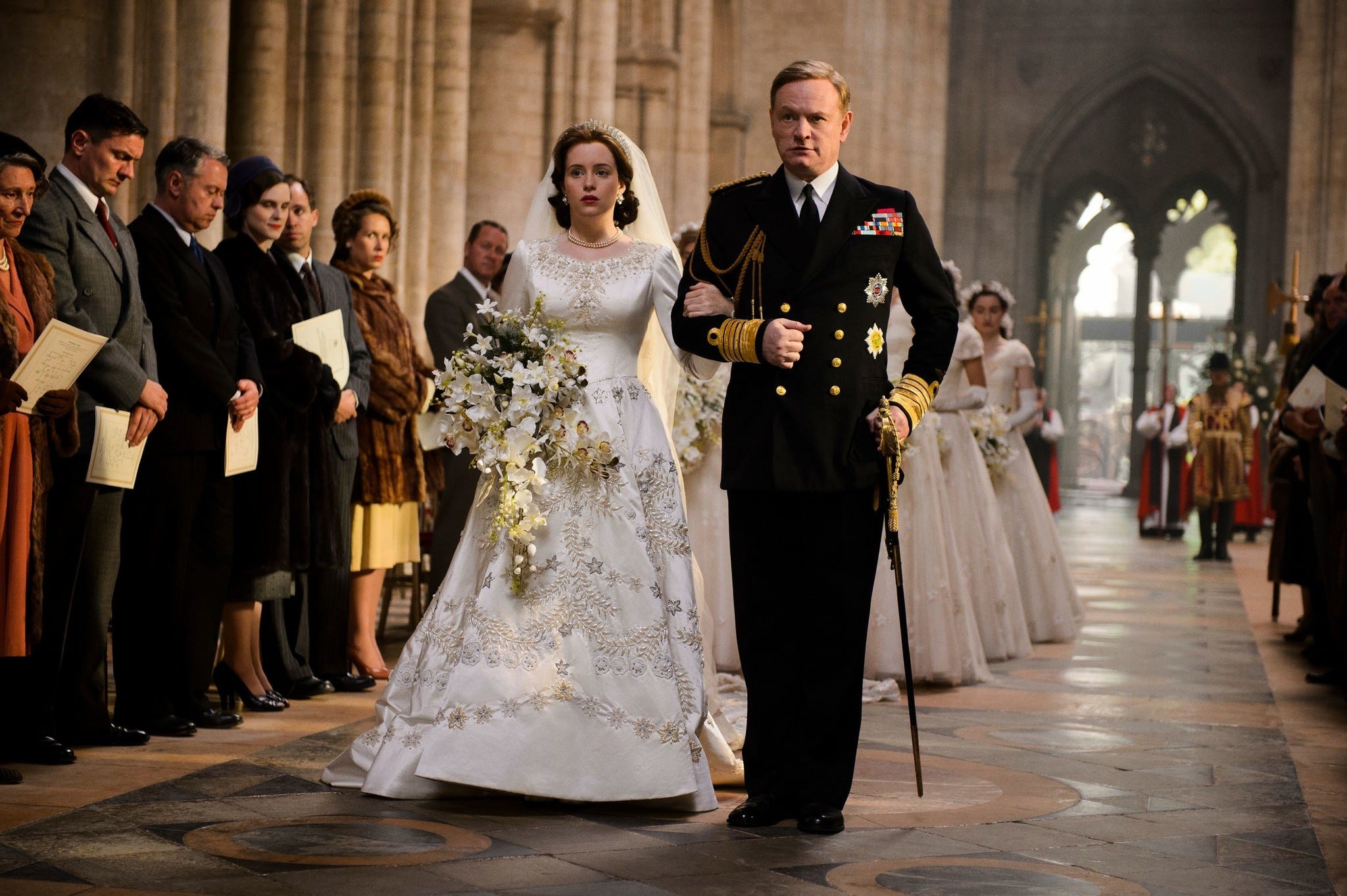
Elizabeth and George are on the same journey, but running in opposite directions. His is a journey of letting go. Hers is a journey of taking up. Neither of them wants to make that journey. The pilot is the story of fate refusing to take their no’s for an answer.
Act One: The Initial Refusal
George essentially enters the episode in denial. After he coughs up blood in the first scene, we see him looking to his footman to ask if he should be worried. He knows he is asking the wrong person, but he’s not looking for the truth. He’s looking to stay in denial. And what better way to do that than to ask a “yes man” who will tell him everything is fine?
In Elizabeth’s early scenes it’s highlighted that she argued (and won) to include the word “obey” in her marriage vows to Phillip. It was very unconventional, controversial and, ultimately, an impossibility. Something that older and wiser characters already know.
Act Two: The Slow Admission
The pilot does something structurally elegant in its second act: it lets the characters continue their denial while quietly closing off every exit.
The act opens with a montage of years passing and the family in general happiness. Elizabeth gets her normal family life, briefly.
Those scenes have a looseness to them, a freedom. She is the happiest we see her in the entire episode. She is playing her chosen role of wife and mother. She even talks about the very domestic task of sewing another gold ring on Phillip’s uniform, like it’s for a child’s scout uniform.
This moment is interrupted when the phone rings with the news that King George is undergoing lung surgery. She is called back, and reminded that she will not be able to run away forever.
Back in London, George has his surgery, and during recovery meets with Churchill. He brings up the idea that they should consider having Elizabeth go on the Commonwealth tour in his stead. When Churchill presses him, he walks it back, saying he was only thinking of preparing for the “distant” future. But we know differently.
Meanwhile, Elizabeth, being back home, is slipping into her destiny almost without noticing. She is “off to work,” leaving Phillip at home in the more traditionally domestic role.
The second act ends when George, coughing up blood again, hears the truth from his doctor. He is still sick and he will die. George turns in this scene. He is no longer running, no longer looking to be coddled. Instead, he asks a silent question of his doctor, “How long do I have?,” and gets his answer.
For him, the denial is over. He is going to die and his daughter is going to be Queen.
Act Three: The Collision of the Inevitable
We have not seen George and Elizabeth together in a scene since the first act, but the third act forces them back together. It opens on the train ride to celebrate Christmas at...Balmoral? (IDK. Not British.)
But they could not be farther apart emotionally. George is wrecked, grappling with his own impending mortality. This is most likely his last Christmas. Meanwhile, Elizabeth is still in a state of childlike naïveté.
In the most touching scene of the pilot, carolers are invited into the home on Christmas Eve and they sing carols for all of the revelers including the King. A young girl approaches him with a gift box and he opens it to reveal a decorated paper crown. As the King places the crown on his head, he joins them to sing a carol. He becomes visibly emotional during the song and even Elizabeth cannot ignore it. I think this is the moment that she knows something is wrong.
We catch up with Elizabeth in the days following Christmas as she plays with her children and watches them ride their tricycles. A butler approaches her and tells her that her father is requesting her in his office.
This clip is not the scene in its entirety, but you can watch that on Netflix. In the full episode the scene starts at 44:30.
This is the crucial scene and it opens with Elizabeth holding the same paper crown that was gifted to her father on Christmas Eve. She is turning it over in her hands, considering it. She is the one holding it now. Not her father. Symbolism working at its best.
She talks to her father about building her forever home with Phillip, but George knows she will be Queen before that house is ever finished. He cannot tell her. So he prepares her the only way he can: obliquely and inadequately, but lovingly. He passes on one of his secrets of the trade.
Then they go on to have an open conversation about what it is to be the monarch and her father asks her to take the Commonwealth tour for him. She knows, but still has not accepted that the true crown will be hers to carry soon.
In the next scene, as she convinces Phillip to accompany her on the Commonwealth tour, she takes another step toward accepting her destiny and the sacrifices that come with it.
The following morning, George and Phillip are preparing for a hunt when George implores Phillip to accept his role in service to Elizabeth, his wife, and the Queen. This scene is staged on a river, and the location earns its weight quietly. He has one task left before his time runs out, and this is it: he must ensure that someone will be there to take care of Elizabeth when he is not.
The final sequence intercuts between George and Phillip on the hunt while Elizabeth enters her father’s office alone. She regards the correspondence box embossed with “THE KING” before she tentatively sits in his chair. She is auditioning the role that will be hers.
The episode ends with the sounds of gunshots as the camera moves forward into fog. The fog symbolizes the unknown of the future. The ringing sound of gunshots evokes a 21-gun salute. They are both about to experience a death. The King’s physical death, and Elizabeth’s metaphorical, as her personhood will be eclipsed by the title.
The Pattern Across Characters
Something that made me question how the writers constructed the pilot was the realization that the theme isn’t confined to George and Elizabeth. It runs through every major character in the pilot.
Churchill wins re-election almost a decade after he last held the role and immediately orders a return to “everything exactly as it was before.” He refuses to accept that anything has or will change.
Phillip is the one who sees everything. He is the one who notices the doctor’s eyes averting at the word “satisfactory.” He is the one who sees the lung that was removed during surgery. He probably knows or intuits more than anyone else in the episode about what is actually happening. And he resists what it means for him personally, because it will change his life as completely as anyone else’s.
The whole pilot is running one idea, one theme, through four different characters. That is not a coincidence. That is architecture. It is disciplined and masterful storytelling.
The Takeaway
When something starts to feel inert in your script, the first instinct is to ask what the character wants. Sometimes that’s the right fix.
But if that doesn’t feel like it’s getting you anywhere, try asking the inverse: what do they not want? What does this character already know, that they are refusing to accept? What truth are they pretending is not in the room?
Denial and resistance are not passive. They are active, effortful, and expensive. They show up in actable behavior: deflection, humor, changing the subject, asking the wrong person the question, saying something true and then immediately walking it back. Those create tension in a scene even when nothing “happens” on the surface.
And that tension is enough to hold an audience. Audiences will watch someone fight the truth for a very long time.